

Your Business Might Change. Your Personal Brand Comes With You.
Why personal branding matters more than ever and why I always start with strategy.
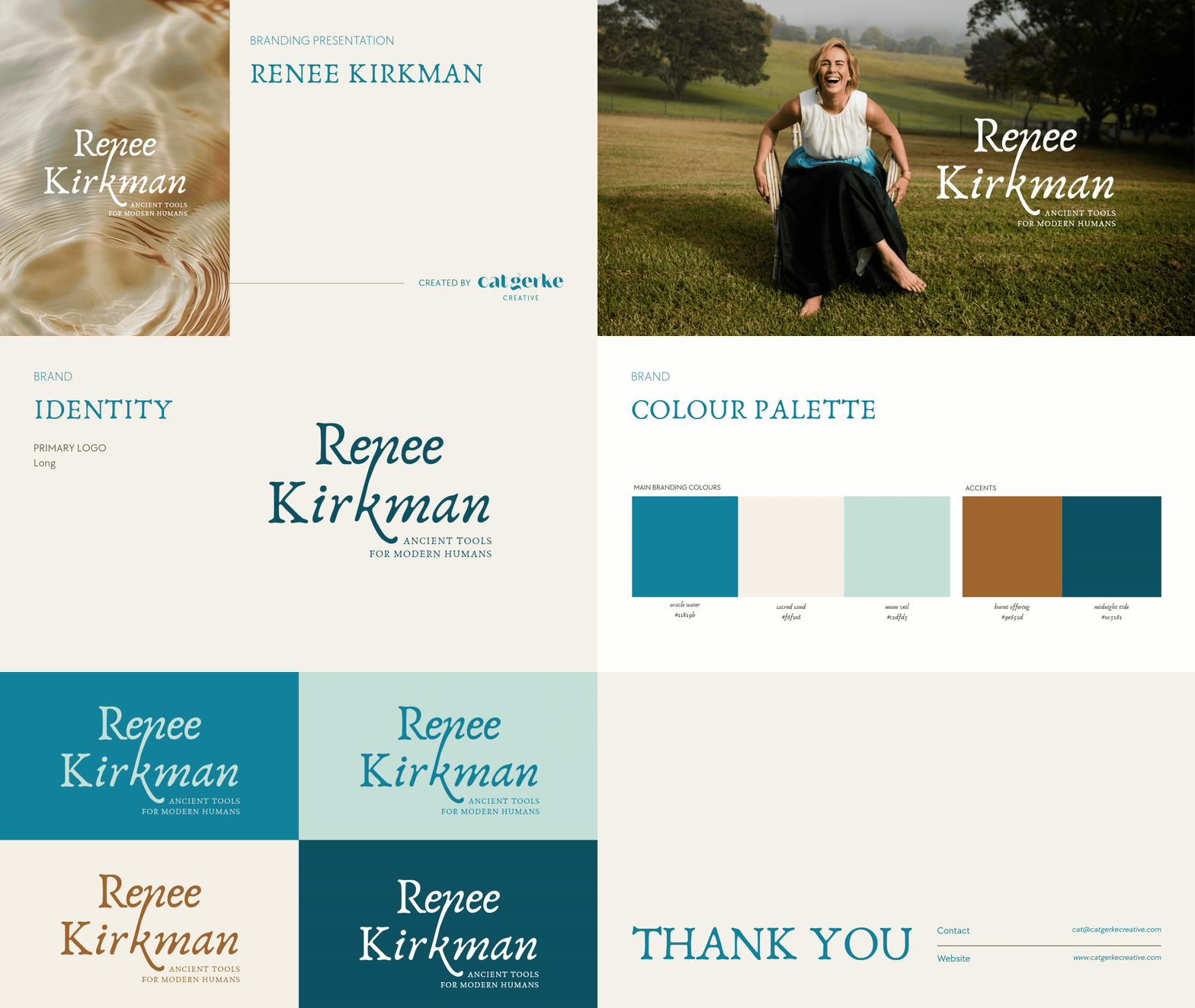
I recently worked with Renee Kirkman on a brand and website refresh, and one of the biggest strategic decisions we made had nothing to do with fonts, colours or logos. It was deciding what the brand actually was. Renee’s business had previously centred around the name Temple of You. But the more I got to know her, her work and the way her clients experience it, the more obvious it became that Renee herself needed to sit at the centre.
Her work spans breathwork, energy, sound, coaching and ancient ritual practices. It is deeply personal. Trust matters. Connection matters. Feeling safe with the person guiding you matters. So why put another brand between Renee and the people she was trying to reach? We repositioned Renee Kirkman as the primary brand and allowed Temple of You to become a sub-brand within that world.
And it got me thinking about something I am increasingly discussing with my clients:
What if the most valuable long-term brand you are building isn’t actually your business? What if it’s you?
We aren’t building businesses the way we used to. The idea that you choose one profession, start one business, put your name on the door and do roughly the same thing for the next 40 years feels increasingly outdated. Especially in the creative and entrepreneurial worlds I tend to work in.
People build businesses. Sell them. Start another one. They consult. They launch products. They write books. They teach. They collaborate. They become ambassadors.

A personal branding photoshoot I love of Lisa Madigan who is an artist but also a creative and event specialist…
They create a completely different offering based on expertise they developed in the last one. Sometimes the business evolves so much that the original name barely makes sense anymore.
And through all of those iterations, there is often one consistent asset sitting in the middle: you.
Your experience.
Your reputation.
Your point of view.
Your network.
Your way of communicating.
Your body of work.
The trust people have already built with you.
That makes personal branding much more than an Instagram trend or something reserved for influencers. It can become a genuine business asset.
There is evidence behind that shift too. LinkedIn has been reporting for some time that audiences increasingly want expertise and insight from identifiable people, not simply polished corporate messaging. In its 2024 research with Edelman, 73% of B2B decision-makers said thought leadership was a more trustworthy way to assess an organisation’s capabilities than traditional marketing materials. At the same time, we are drowning in more content than ever. Generative AI has made producing something incredibly easy. Producing something recognisable, credible and genuinely connected to a human being is another matter entirely. LinkedIn identified that tension in 2025, describing authenticity and trust as increasingly important as AI-generated content multiplies.
Turns out being an actual human is still a reasonably good marketing strategy. Who knew.
Your personal brand is not the same thing as your business brand.
This distinction is important. I am not suggesting every business should immediately become Firstname Lastname Pty Ltd.
There are very good reasons to build an independent business brand. Maybe you want to sell the company one day. Maybe you have a team and the business needs to represent something much larger than you. Maybe you operate multiple brands. Maybe your personal brand feeds into the company without needing to become the company.
The strategy is different for everyone.
But even when there is a separate business brand, the founder or expert behind it can still be an incredibly valuable channel for building awareness, trust and authority.
Think of your personal brand as the thread that can move between businesses. The business might be one chapter. You are the book.
And yes, if you are intentionally building a company to sell, there eventually needs to be enough brand equity, systems and trust in the business that it can survive without your face plastered across everything. Personal brand strategy isn’t about creating founder dependency.
It is about understanding the relationship between the person and the business, then using both strategically.
Personal branding is not just making your name into a logo.
This is where branding sometimes gets reduced to aesthetics. Someone decides they need a personal brand. Suddenly we are discussing serif fonts, professional photographs and whether their initials should be intertwined inside a tasteful little monogram.
Lovely but that isn't really the brand. When I develop a personal brand identity, I absolutely care about how it looks. The visual language should feel like the person.
In Renee’s case, that meant creating something bold but soft. Spiritual without leaning too heavily into an “ancient” aesthetic. Feminine without becoming overly feminine. It also meant questioning the visual conventions of her industry. There is a particular aesthetic that exists throughout the spiritual and wellness space: beige, black, gold, perhaps a moon somewhere for good measure.
That wasn’t Renee.
She already had a strong connection to a very bright turquoise within her existing brand. Rather than removing it because I wanted to impose an entirely new aesthetic, we evolved it. We softened it. Refined it. Built a more sophisticated palette around it. It stayed colourful. It stayed recognisable. It stayed Renee.
Good branding isn't about making everybody look expensive in exactly the same way. It is about creating a visual language that supports the positioning and that positioning has to exist before I start choosing colours.

This is why I begin with strategy. Always.
One of the biggest mistakes I see with personal branding is starting at the content stage:
“What should I post?”
“How often should I post?”
“Should I be on LinkedIn?”
Those are distribution questions.
We haven't even established what we are distributing yet. Before I can build a personal brand strategy, I want to understand things like:
What are you actually trying to become known for?
What expertise do you want to own?
What do you believe about your industry?
Where do you disagree with the standard approach?
Who needs to know you?
Do you want the personal brand to support one company, or does it need to be broad enough to move with you into whatever comes next?
And importantly: How much of yourself do you actually want to share?
Because having a personal brand does not mean handing the internet unrestricted access to your life. You can be visible without being exposed. You can be personal without making everything private public. You can build familiarity without turning breakfast, your relationship and your emotional state into content pillars.
Those boundaries are part of the strategy too.
Then we work out what you actually have to say.
This is where personal brand strategy moves into marketing strategy.
Your social media should not be a random collection of:
a client project > a quote > your coffee > an educational carousel > a holiday photo > something vaguely inspirational > BUY MY THING > back to coffee (I am partly talking to myself with the coffee thing, I am notorious for not following my own rules).
There should be a reason for the content. A strong personal brand needs recognisable territory.
For one person, that may be three or four very specific areas of expertise. For another, it might deliberately combine multiple parts of their work because the intersection between them is exactly what makes them interesting.
The goal is not to talk about one microscopic subject forever. It is to create enough consistency that your audience begins joining the dots for you.
Oh, Cat? Branding, marketing strategy, creative businesses.
Renee? Breathwork, energy, embodied leadership, personal transformation.
You want associations to form. That only happens through repetition. Not mindless repetition, but strategic repetition. Different stories. Different formats. Different angles. The same underlying positioning.
A personal brand also needs a point of view.
Expertise alone isn't always memorable. Plenty of people know things. The interesting part is what you think about those things.
What have you learned from actually doing the work?
What are you tired of seeing in your industry?
What do clients routinely misunderstand?
What do you do differently?
This is where thought leadership starts becoming useful but it does not mean desperately trying to invent a controversial opinion every Tuesday because someone told you “hot takes perform well”. Your perspective can simply be informed. Specific. Experienced. Useful.
LinkedIn's own research into thought leadership repeatedly comes back to this relationship between expertise, credibility and trust. It isn't simply about posting frequently; it is about consistently giving people useful insight that helps them understand how you think.
For service businesses in particular, how you think is often part of what somebody is buying.
Social media should make your expertise visible before someone needs it.
This is another reason I care so much about strategy. Not everybody following you needs your service today. Most won't. But that doesn't make them irrelevant. A strong personal brand creates an ongoing body of evidence.
Someone follows you for six months. > They see how you approach a problem. > They understand what you value. > They see client work. > They hear your opinion. > They watch you explain something complicated simply. > They begin to recognise your name.
Then one day they need exactly what you do or their friend does or somebody asks them: “Do you know anyone who can help with this?” And ideally your name comes to mind.
That is very different from expecting every Instagram post to generate an enquiry by 4pm. Personal brand marketing is often cumulative. You are building memory.
Your website has a job here too.
Personal branding cannot live entirely on social media. Algorithms change. Platforms rise and fall. Your reach changes. Accounts disappear.
Your website is where all those fragments of the brand can come together. It explains who you are. What you do. Who you help. What you believe. How somebody can work with you. It creates somewhere for people to go after discovering you through social media, search, PR, a podcast, an event or a referral.
This was another important part of Renee’s project. We didn’t rebuild her website for the sake of having something shiny and new. We kept the bones that worked and fixed what didn't. We improved the mobile experience. Clarified the services. Refined the imagery. Developed the copy. Built SEO thinking into the structure. Made Renee herself more present. And importantly, connected the new visual identity to the broader positioning. No unnecessary 47-page website. No setting fire to perfectly functional things just so I could invoice her to rebuild them.
Keep what works. Fix what doesn't. This is basically my branding philosophy in a sentence.
Your personal brand should be able to grow up with you.
I think this might be the most important part. If we are going to invest time and money into building a personal brand, it shouldn't trap you. You don't want to become so closely associated with one tiny offer that changing direction feels impossible. You also don't want a brand identity built around whatever visual trend happened to be popular the year you launched it.
A good personal brand needs a strong enough foundation that it can evolve as you do. Your offers might change. Your business model might change. You might sell the company. You might start another. You might become less hands-on. You might teach what you used to deliver. You might discover that the thing people value most about you is not actually the thing you thought you were selling. The strategy should leave room for that.
Because ultimately, personal branding isn't about packaging yourself into a neat little box. It is about intentionally building the reputation around your name. And that is why I don't start with the logo.I start with questions. Lots of them. Sometimes annoyingly deep ones. The kind that make clients write back saying, “No one has ever asked me that before,” or, “I've actually never thought about that.”
Because before we decide what your brand should look like, I need to understand what you are building. Before we decide what you should post online, we need to understand what you want to be known for.
The identity comes from the strategy. > The website comes from the strategy. > The content comes from the strategy. > The partnerships come from the strategy. > The visibility comes from the strategy. Your personal brand isn't just what your Instagram looks like. It is what people understand about you when you aren't in the room and if you are going to spend years building that reputation, it is worth being intentional about what you're building it around.