

Maybe “Enough” Is Actually a Business Strategy

I think I missed the meeting where we collectively decided the ultimate goal of running a business was to make the maximum possible amount of money while doing the minimum possible amount of work. Lately I seem to be seeing the same advice everywhere. Monetise every conversation. Charge for access. Never give your expertise away. Stop selling your time. Package the transformation, not the hours. Build passive income. Scale without working more. Make money while you sleep.
And look, I get it. The cost of living is obscene. Running a business is expensive. Expertise absolutely has value, and there are plenty of incredibly talented people — particularly women and creatives — who have spent years dramatically undercharging for what they do.
I am also fully aware that I am probably the worst possible poster child for pricing strategy.
I work fast. Really fast. It is partly experience and partly just how my brain works. Give me a business, a problem, a website, a brand or a messy pile of ideas and I can usually see the thread through it pretty quickly. Because of that, when I quote for branding, website design, marketing strategy or creative direction, I am often substantially cheaper than comparable businesses. Sometimes by 50 per cent. Sometimes closer to 80.
That is not because I think my work is worth less, and it is not because I am desperately trying to win the job. It is simply because if I can do something properly in a day, I have a very hard time looking someone in the eye and charging them for three days just because somebody else might take three days to arrive at the same result. There is, of course, an obvious problem here. If you were my client and you told me exactly what I just told you, I would probably tilt my head slightly and say, “We should probably have a look at your pricing.” So yes, the hypocrisy is absolutely noted.
I actually like working
Maybe this is where my country upbringing comes in. I was raised by parents who thought working hard was fairly non-negotiable. You worked, you helped, you did what needed to be done, and annoyingly some of that rubbed off because I actually like working. I like making things. I like solving problems. I like getting inside somebody’s business and figuring out why something is not quite working. I like the moment a client has been talking for 40 minutes and suddenly I can see the thing they have been trying to articulate for the last three years. I like building brands, pulling websites apart, fixing offers, developing marketing strategies and talking to clever people who are trying to make something of their own.
My dream has never really been to create some enormous passive-income empire that allows me to work two hours a week from a tropical island. Firstly, sand. Absolutely not. Secondly, I do not actually want to remove myself entirely from the work.
The work is the bit I like. That probably sounds mildly offensive in an online business world obsessed with doing less, automating more and building something that apparently runs beautifully without you, but I am not sure I want to build a business designed to eventually remove me from all the parts I enjoy.
I have priced my business at a point where I can cover my costs, live comfortably, pay my bills, buy something ridiculous occasionally without launching a forensic investigation into my bank account, and put some money away for the proverbial rainy day.
Could I optimise that further? Absolutely. Could I probably put my prices up tomorrow and still get work? Probably. Could I turn every conversation into a paid consultation, package every piece of knowledge I have into a digital product and spend the next twelve months working out how to squeeze another percentage point out of every interaction? Sure.
I just do not really want to. I do not want to live beyond my means, and increasingly I am not sure I want to price beyond my needs either.
That does not mean pricing irresponsibly. It does not mean ignoring profit, and it certainly does not mean working yourself into the ground in the name of being generous. It just means deciding for yourself what a successful business is actually supposed to provide.

Money is not the only currency in business
This is probably the part of modern business advice I struggle with most. There seems to be a growing idea that any exchange that does not immediately result in money changing hands is somehow a failure to monetise properly. I do not really buy that.
Some of the most valuable things that have happened in my career have started with conversations that were not billed. A coffee with another business owner. Helping someone figure out what kind of specialist they actually need, even when that specialist is not me. Making an introduction. Swapping expertise. Saying, “You help me with this thing you are brilliant at and I will help you with this thing I am brilliant at.”
Technically, none of that is maximising revenue. But there is currency in trust. There is currency in generosity. There is currency in relationships, reputation, referrals, collaboration and being the person somebody remembers six months later when their friend says, “Do you know anyone who can help me with this?”
I have rarely had an open, useful conversation with another business owner and thought afterwards, well, that was financially disastrous.
Maybe they become a client. Maybe they do not. Maybe I point them towards someone better suited. Maybe they teach me something. Maybe absolutely nothing happens for two years and then an email arrives out of nowhere. That is still business.
I think sometimes we have become so focused on extracting measurable value from every interaction that we forget businesses are still built by people. And people remember generosity, usefulness, honesty and whether talking to you actually felt good. Not every valuable thing needs an invoice attached to it immediately.
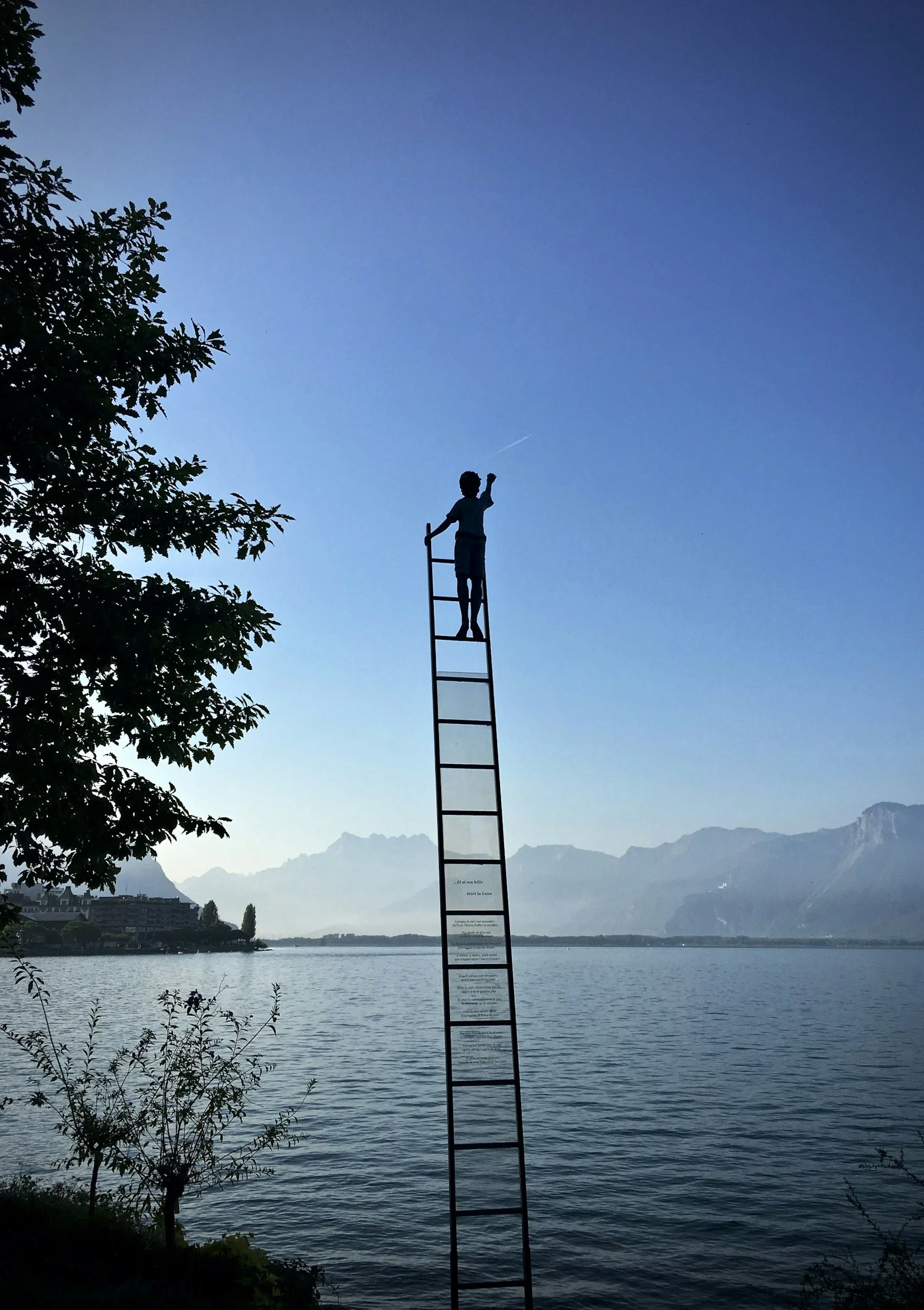
The problem with a finish line that keeps moving
There is always another milestone available. More revenue. A bigger team. Higher prices. Another product. More followers. More automation. More scale. There is always someone online ready to tell you the next version of your business should be bigger than the one you have now. And if you never consciously decide what enough looks like, the internet will quite happily keep moving the finish line for you forever. That is perhaps what bothers me most about a lot of business advice. It assumes we are all trying to build the same thing. We are not.
Somebody genuinely wants to create a huge company, sell it and retire at 40. Brilliant. Someone else wants a studio with five employees. Someone wants to remain a one-person business forever. Someone wants to work four days a week. Someone wants to earn enough to pay the mortgage, take a good holiday every year and still be able to pick their kids up from school.
And somebody else might genuinely love working five days a week because — controversial as this apparently is — they enjoy their job. None of those businesses are inherently more successful than the others.
That is the part I think we sometimes lose when we talk about ambition. Ambition does not have to mean extracting the maximum amount of money from every available opportunity. Sometimes ambition might look like building a business that fits your life incredibly well.
One that makes good money. One that gives you interesting work. One that gives you enough freedom. One that allows you to work with people you genuinely like. One that leaves space for generosity, curiosity and conversations that do not begin with a booking link. And perhaps most importantly, one where you know what you are actually working towards rather than endlessly pursuing whatever version of success Instagram served you that morning.
For me, I am becoming increasingly comfortable with the idea that enough can be a goal. Enough money. Enough work. Enough growth. Enough freedom. Not because I lack ambition, but because I would quite like to notice when the thing I have been working towards has actually arrived. Maybe the goal does not always need to be bigger. Maybe sometimes you are allowed to look around at the business you have built, the people you get to work with and the life it allows you to have and think, actually, this is pretty bloody good.