

There is a particular stage of business growth where you suddenly realise the work you are doing has become considerably more sophisticated than the logo you made at 11pm in Canva four years ago. And I say that with love. Most businesses do not start with a beautifully resolved brand strategy, a perfect visual identity and a five-year positioning plan. They start with an idea, some enthusiasm, a terrifying amount of admin and a vague sense that perhaps they should have an Instagram account. You make the best decisions you can at the time, and then you get on with the much harder job of actually building the business.
Then the business changes.
Your experience grows. Your services become better. Your prices change. You work out which customers you love and which ones you would very happily never work with again. You become clearer about what you want to be known for. Meanwhile, your branding can stay completely frozen in time. That is usually when people start thinking they need a rebrand.
Sometimes they do. Sometimes they need a brand refresh. Sometimes the logo is absolutely fine and the real problem is the website, messaging, photography or the fact that every piece of marketing looks like it came from a different business. So before you burn everything down and begin pinning fonts to a new Pinterest board, here are seven signs your business may genuinely have outgrown its branding.
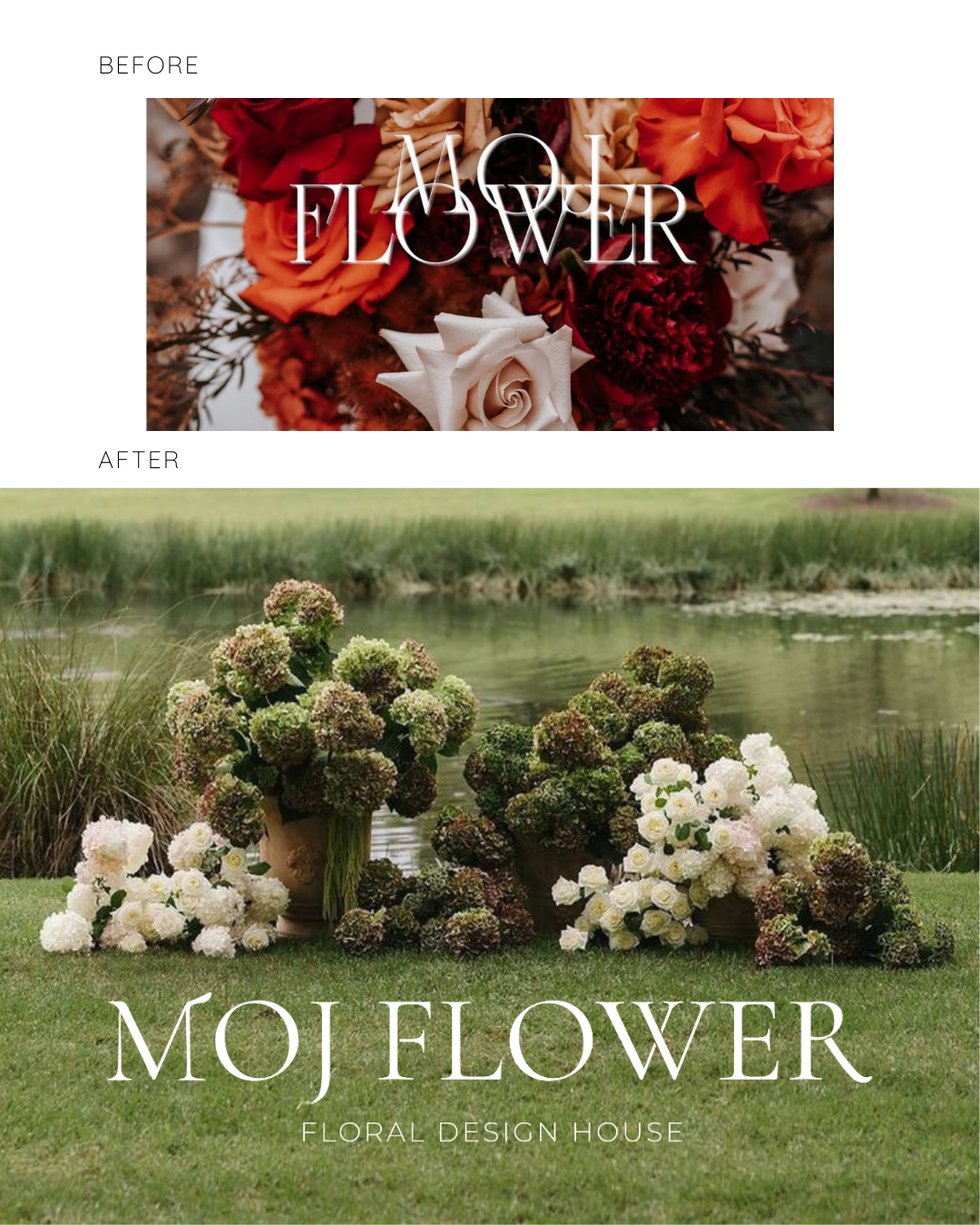
Rebrand by Cat Gerke Creative
1. Your prices have increased, but your brand still feels entry-level
This is one of the biggest clues. Maybe you started out charging $500 for something you now charge $3,000 for.
Your experience has increased. Your process is stronger. Your service is more sophisticated. Your customers are getting a much better result. But visually, nothing has changed.
The logo, website, imagery and social media still feel like they belong to the business that was charging the original price. This creates a perceived value problem. A potential customer cannot see the years of work, knowledge and refinement that have gone into your service. They can only respond to the signals in front of them.
If everything visually says “entry-level” before they reach a premium price point, you have created friction. They are not going to sit there thoughtfully analysing the relationship between your visual identity and commercial positioning. They are just going to think: “That seems expensive.”
Good branding helps the customer understand the level of business they are dealing with before they ever see the number.
2. You are attracting customers you have outgrown
I see this alot with interior design studios… Sometimes the clearest sign that a brand is no longer working is not how it looks. It is who keeps walking through the door.
If your ideal customer has changed but your branding, messaging and content are still speaking to the audience you started with, you may keep attracting exactly the kind of work you are trying to move away from.
This can be incredibly frustrating because internally you are thinking:
We don’t really do that anymore. But externally, everything still says that you do. Perhaps you want larger projects but your brand still feels small and transactional. Maybe you want more sophisticated clients but your messaging is still very price-led. Perhaps you want to move from being seen as a supplier into being seen as a strategic expert. Your branding needs to support that shift.
This does not mean becoming cold, corporate or unrecognisable. It means making sure your visual identity and messaging are speaking clearly to the people you want more of. Because if the wrong customers keep finding you, it is worth asking whether you are still accidentally inviting them in.
3. You are slightly embarrassed to send people to your website
This one is fairly simple…. If someone asks for your website and your immediate response is: “Just ignore the homepage.” or “The work on there is really old.” That is probably useful information.
Your website is often one of the first places a potential client goes to validate whether the business they found on Instagram, Google or through a referral is actually the right fit. If you hesitate to send them there, imagine how confident it is making them feel. An outdated website does not necessarily mean you need a full rebrand, but it often exposes the gap between the business you are now and the way it is being presented.
Your services may have changed. Your portfolio may be stronger. Your customer may be different. Your tone may have evolved. Yet the website is still introducing everyone to the old version of you. A strategic website redesign can sometimes solve more than a logo change ever could… Plus a new website doesn’t need to be complicated…
4. Your website, Instagram and proposal look like three separate companies
A lot of businesses do not have bad branding. They have fragmented branding.
The Instagram is using one set of colours because somebody found a Canva template they liked. The website was built three years ago using different fonts. The proposal document has another logo version entirely. The email signature somehow contains a colour no one remembers approving. I get it. Brands evolve organically, especially in small businesses. You make things as you need them and, before long, you have accumulated an entire visual ecosystem that nobody quite planned.
The problem is that consistency is one of the things that makes a business feel established. Your customer should be able to move from Instagram to your website, then receive a proposal or open an email and feel like they are still dealing with the same brand. Not because everything needs to look identical, but because there should be a recognisable visual language running through it.
If the business only looks branded when the logo is enormous, you probably need a stronger identity system.
5. You keep ‘fixing’ the brand by adding more things
This is a very common phase. Something does not quite feel right, so you add another font. Still not right. Perhaps another colour? A new social template. A different logo lock-up. Maybe an icon. Perhaps the issue is that the beige is not quite beige enough. Before you know it, you have six fonts, 14 colours and enough Canva templates to run a small television network.
More is rarely the answer.
When a brand is not working, the problem is often not that it needs more decoration. It is that there is not enough clarity around what the brand is supposed to communicate. This is where going back to strategy becomes useful.
Who are we talking to?
How do we want the business to be perceived?
What should the brand feel like?
What are the three most important attributes we need to communicate?
Once those answers are clear, the visual identity usually becomes simpler rather than more complicated. A strong brand does not need every idea. It needs the right ones.
6. Your services have changed, but your messaging has not
This happens constantly. The business evolves operationally long before anybody updates the words. You started by offering one thing. Then clients began asking for something else.
You developed a better service. You combined two offers. You became more specialised. You moved upmarket. You stopped doing the thing that is still taking up half the homepage.
Suddenly your website technically contains all the right information, but it no longer tells the right story. This is often mistaken for a branding problem when it is actually a positioning and messaging problem. A new logo will not fix unclear services. A different colour palette will not help if nobody understands what you actually do. Sometimes the highest-value part of a rebrand is the work that happens before anything visual: clarifying the offer, customer, positioning and language. Because when the business is clear, the brand has something useful to communicate.
7. You are doing much better work than your brand suggests
This might be the biggest one. You look at your portfolio and think: This is really good.
Then you look at your website and think: Why does none of this feel like us?
That gap matters.
Your brand is not there to artificially inflate the quality of your business. It should communicate the quality that already exists. If you are producing exceptional work, delivering a highly considered service or operating at a level that your branding does not reflect, then the visual identity may actually be underselling you. And that can affect everything from the type of enquiries you receive to the partnerships, opportunities and price points people associate with your business. Sometimes rebranding is not about becoming something new.
It is about finally showing people what has already changed.
So, do you need a rebrand or a brand refresh?
Not necessarily a complete rebrand. This is where I think businesses often panic and assume every sign above means the entire identity needs to be thrown away. It does not.
There may be plenty worth keeping. Your business name may have strong recognition. A particular colour may already have equity. The logo might actually be fine. Your customers may already know certain elements of the brand. A good brand refresh protects what still works and strengthens what does not.
A full rebrand tends to make more sense when there has been a bigger shift in the business: a new audience, significant change in services, different positioning, major growth, a change of name or a visual identity that simply cannot support where the company is heading. The point is not to change things for the sake of having something new to reveal on Instagram. The point is to solve the right problem.
Before you rebrand, ask these questions
If you are looking at your business and thinking some of this feels uncomfortably familiar, start here.
Who do you want more of?
What does that customer value?
What do you want to be known for?
How should the business feel when someone discovers it?
Does your current brand support your current pricing?
Does your website clearly explain what you now offer?
What parts of the existing brand still have value?
And perhaps the most useful question:
If you launched this business today, knowing everything you know now, would you build the brand the same way?
If the answer is no, that does not mean the original branding was a mistake. It probably did exactly the job you needed it to do at the time. You have simply grown.
Your branding is allowed to grow with you
I run my own business, so I understand how strangely easy it is to become blind to this stuff. You are inside the business every day. You know what you mean. You know why the services make sense. You know which page is out of date and which logo version you secretly hate. Your customer does not. They only experience what you put in front of them. So if your work, experience, customer or ambitions have changed significantly, it is worth asking whether your brand is helping people see the business you have become.
Maybe that means a full rebrand.
Maybe it means refining what already exists.
Maybe you actually need a better website, clearer copy or stronger photography.
The useful part is working out which one before you start changing things. Because the answer is not always “new logo”. Sometimes the logo has been sitting there perfectly innocently while the rest of the business moved on without it.
THINK YOUR BUSINESS HAS OUTGROWN ITS BRAND?
At Cat Gerke Creative, I work across brand strategy, brand identity, website design and marketing, which means I can look at the whole picture rather than assuming the answer is always a rebrand. If you know something needs to shift but you are not sure whether that means a new identity, a brand refresh, a website redesign or simply clearer positioning, tell me what is happening in the business. We’ll work out what actually needs attention next.