

The Best Australian Resources for Creative Small Business Owners
Running a creative business is a slightly ridiculous combination of doing the thing you are actually good at and then being expected to know everything else required to operate a functioning company.

You might be an incredible interior designer, photographer, artist, florist, stylist, consultant or product designer. Fantastic. Unfortunately, at some point somebody is still going to ask whether you're registered for GST, where your privacy policy is, how your invoices work, whether you've checked your business name, what your shipping costs are and what exactly your marketing plan is.
Nobody really warns you about that bit.
I run my own creative business, work across other people's businesses every day and am also part of a business partnership, so I've accumulated a fairly substantial list of websites, tools and resources that either make running a business easier or answer the questions I absolutely do not want to answer from memory. Some are Australian. Some aren't, but work particularly well for Australian businesses. Some are glamorous. Some are very much not.
Unfortunately, the boring ones are often the useful ones.
So, if you're starting or growing a creative small business in Australia, these are some of the places I think are worth bookmarking.
1. Business.gov.au — start here before asking Google 47 separate questions
This is probably the least sexy recommendation in this article, but perhaps the most useful.
The Australian Government's Business website has resources covering starting a business, choosing a structure, business names, ABNs, tax registrations, licences, finances, marketing, websites and hiring. It also has actual downloadable tools for things like business plans, marketing plans, SWOT analyses, cash-flow planning and risk management.
And unlike the person explaining business structures in a Reel filmed from their car, this information is coming from the Australian Government. I particularly like the Grants and Programs Finder, because you can filter opportunities by state, business type, industry and the kind of assistance you're looking for — including funding, mentoring, digital support, exporting and business growth. It is worth checking periodically rather than assuming somebody will magically email you when a relevant grant becomes available.
2. Australian Business Register — because yes, eventually we need to talk about your ABN
If you're at the very beginning of starting a business, the Australian Business Register is where you can apply for an Australian Business Number. An ABN is the 11-digit identifier used for your business or organisation, and the ABR provides the official application process and information about eligibility.
This sounds obvious, but I mention official links because there are plenty of third-party websites that make very simple government registrations look like paid professional services. If something is a government registration, I always start by finding the actual government website.
3. ASIC — check the name before you have 600 business cards printed
Speaking as someone who works in branding: please check the business name properly before falling deeply, emotionally and financially in love with it. ASIC is responsible for business-name registration in Australia. Generally, if you're operating under a name other than your own personal name, you'll need to register that business name.
And this is an important distinction:
Registering a business name is not the same thing as owning a trade mark.
ASIC itself makes that distinction. Registering the name does not automatically give you the same protection as registering a trade mark.
Which brings me neatly to...
4. IP Australia — before we build an entire brand around a name you can't protect
IP Australia's TM Checker is something I think more small businesses should know exists.
It lets you run a free preliminary check of a proposed word or logo trade mark and gives an early indication of potential issues before you move further into the application process. IP Australia is very clear that the check isn't a guarantee of registration, but it is a very useful starting point.
There is also the full Australian Trade Mark Search, which lets you search existing applications and registrations. If you're investing significant money in naming, branding, packaging, signage and a website, this isn't really something I'd leave until the end.
You do not want to discover you've built an entire identity around a name someone else already has strong rights over after the boxes have arrived from the printer.
Explore IP Australia TM Checker
5. Canva — yes, designers use it too
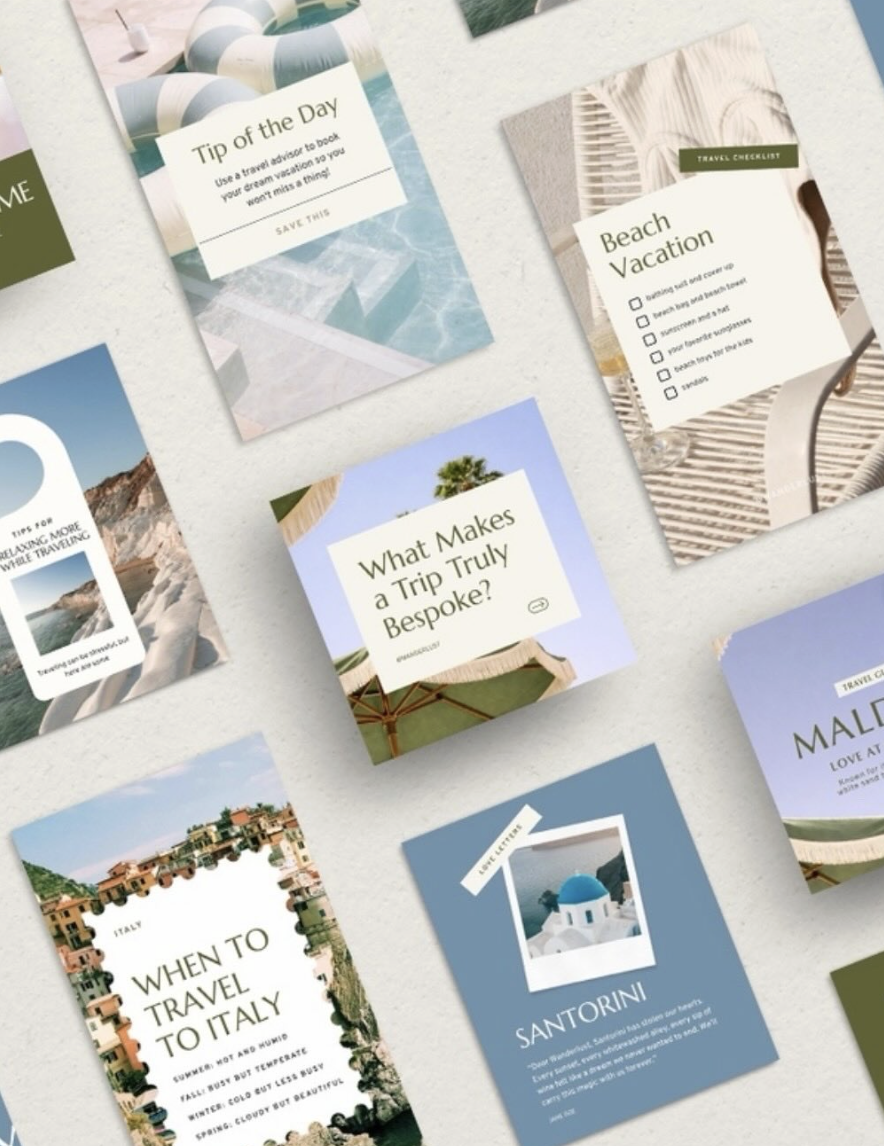
There appears to be a lingering idea that professional designers are supposed to recoil dramatically whenever somebody says Canva.
I don't.
Canva is incredibly useful.
I wouldn't necessarily build every piece of a bespoke identity inside it, but for actually running a small business day-to-day, it's brilliant. Once your brand has been established properly, Canva's Brand Kit allows you to store your logos, colours, fonts, imagery, templates and brand guidelines in one place. That means your team isn't recreating a shade of green by eye every Wednesday.
You can create templates for social media, proposals, presentations, price guides, lead magnets, Stories, newsletters and internal documents while retaining consistency.
Canva Pro also includes content-planning tools for designing and scheduling social content.
The danger with Canva isn't Canva. t's opening Canva every morning and choosing an entirely new aesthetic because the template looked nice. Use it as a system, not as a slot machine for brand identities.
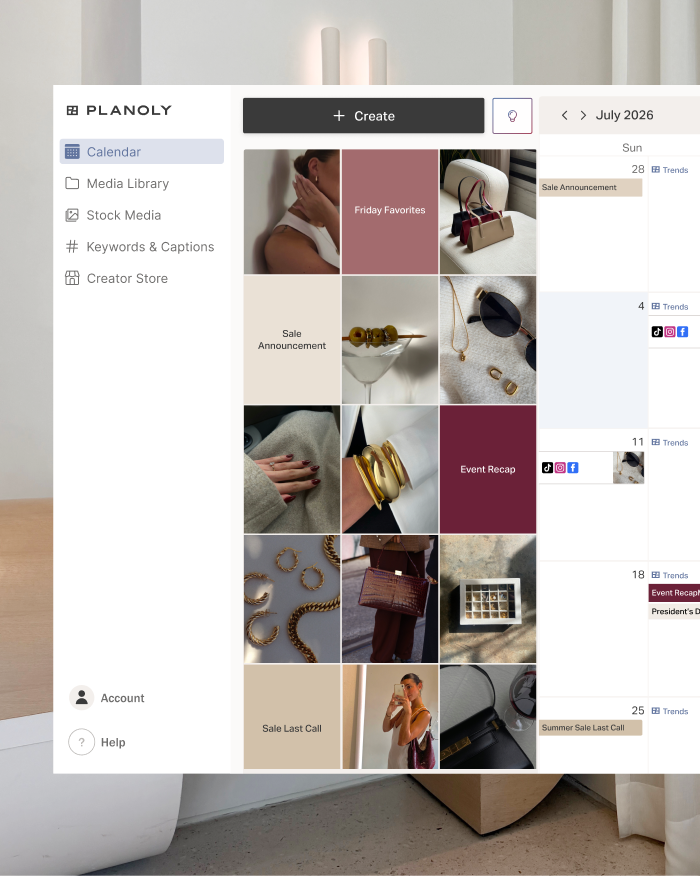
6. Planoly — because your marketing strategy shouldn't live entirely in your Notes app
I use Planoly for social media management because I like being able to see the content ahead of time rather than treating social media as a daily emergency.
Planoly currently supports planning and publishing across Instagram, Facebook, TikTok, LinkedIn, Pinterest, YouTube and Threads, with content managed from a multi-channel workspace.
For a small business owner, the value isn't simply scheduling.
It is being able to stand back and see:
Are we talking about the same thing 14 times?
Have we forgotten an entire service?
Are we promoting constantly and educating never?
Does this month's content actually relate to what the business is trying to achieve?
Planning content in advance makes it much easier to treat social media as part of the marketing strategy rather than something you remember to do at 9.47pm.
7. Xero — because knowing whether you're actually making money is useful
Creative people have a remarkable ability to become extremely interested in rearranging an Instagram grid when the alternative task is reconciling the accounts. Unfortunately, cash flow remains quite important.
Xero is widely built around the needs of Australian businesses and includes invoicing, expense management, bank reconciliation, GST/BAS functionality, payroll on applicable plans, reporting and cash-flow tools. For me, one of the bigger shifts that happens when a creative practice becomes a proper business is moving away from knowing vaguely that “things seem busy” and towards actually knowing:
What are we earning?
What does it cost us to earn it?
Which services are profitable?
Who hasn't paid?
What are our expenses?
What is coming up?
Revenue is not profit, no matter how attractive the number looks in an Instagram caption. Xero also integrates with a large ecosystem of other business apps, which becomes increasingly useful as a business grows.
8. Hnry — particularly interesting if you're a sole trader
If you're a freelancer, consultant, artist or creative operating as a sole trader and the accounting side makes your eyes glaze over, Hnry is worth investigating.
Hnry is specifically designed around sole traders. Its service can calculate and pay tax as income comes through its account, manage expenses and handle tax lodgements, alongside access to accounting support. They also have a genuinely useful resource library for Australian sole traders covering GST, deductions, tax rates, expenses and other areas of self-employment.
It won't be the right setup for every business structure, obviously, but if you're in that awkward phase between “I occasionally freelance” and “oh, apparently I run a business now”, it's worth a look.
9. BLOOM Crm — because every service business needs a better way of managing all the moving pieces.
One of the business tools I genuinely love is BLOOM CRM. I’ve tested quite a few client management systems over the years, and for service-based and creative businesses, this is the one I keep coming back to. It keeps your leads, client communication, contracts, invoices, questionnaires and project deliverables all in one place, so you’re not constantly digging through emails, folders and random spreadsheets trying to work out where everything is. It’s particularly great if you’re a designer, photographer, consultant, creative or small business owner managing multiple clients at once, because it gives you a really clear view of where every enquiry and project is sitting. It’s easy to use, doesn’t feel unnecessarily complicated, and compared with a lot of CRM platforms, it’s also really reasonably priced. If you’re looking for a CRM for your small business that will make the admin side of client management feel significantly less chaotic, BLOOM is my pick.
Explore Bloom CRM here.
10. Australia Post MyPost Business — if your creative business also involves boxes

Product businesses have their own special category of things nobody tells you about. Packaging. Returns. Labels. Damaged parcels. Someone in Perth ordering something enormous. Someone in New Zealand ordering something tiny.
Australia Post's MyPost Business is designed for smaller-volume business shipping and offers an online portal for labels, tracking, account management and pickups, with savings bands that increase with eligible shipping spend. It can also integrate with ecommerce platforms including Shopify. Once your order volume becomes substantially larger, Australia Post also has other business products including eParcel and StarTrack arrangements.
The exciting part of starting a product brand might be designing the packaging. The commercially useful part is working out what it costs to send it to Darwin. Do both.
11. Square — useful when the business exists online and in the real world
For makers, artists, market stalls, studios, workshops, retail and businesses that need to accept payment both physically and remotely, Square is worth knowing about.
Its Australian offering includes point-of-sale tools and digital invoicing, including invoices that customers can pay through several payment methods. This is one of those resources that makes more sense when you think about the whole customer journey. Maybe somebody finds you on Instagram, books a workshop online, buys something from you at a market six months later and then commissions a custom piece.
Your systems don't need to be enterprise-level.
They just need to make giving you money surprisingly easy.
A principle I am very fond of.
12. Creative Australia — if your creative practice falls within the arts
If your business crosses over with an artistic or cultural practice, Creative Australia should absolutely be on your radar.
Its opportunities portal lists current and upcoming grants, fellowships, awards and other programs and can be filtered by applicant type, availability, opportunity and art form. Eligibility varies significantly between programs. Creative Australia accepts applications from practising artists and creative workers across eligible individual, group and organisational opportunities, so this is something to investigate rather than assume you're either automatically eligible or automatically excluded from.
And please don't look at grant applications for the first time at 11.30pm on closing day.
Creative Australia itself recommends allowing time to identify the correct opportunity, check eligibility, gather support material and complete the application.
The same rule applies to grant applications as packing for holidays.
You can do it at the last minute. It just becomes considerably less enjoyable.
Explore Creative Australia opportunities
13. Australian Small Business and Family Enterprise Ombudsman — bookmark this before you need it
This one sits firmly in the category of resources you hope you never become extremely familiar with. The Australian Small Business and Family Enterprise Ombudsman, or ASBFEO, provides information and support for small businesses around issues including disputes and business debt. For example, its debt resources provide guidance both when someone owes your business money and when your business owes money, including options for trying to resolve the situation before escalating it further.
Running a creative business still means running a business.
At some point there may be a late payer, a contract dispute or a commercial situation that no amount of beautiful branding is capable of fixing.
Know where the proper resources are.
And then there are the resources your business should be building for itself
The most valuable business resources aren't always another subscription.
As your business grows, start creating your own internal library.
Your brand guidelines.
Your proposal templates.
Your service descriptions.
Your frequently used emails.
Your photography library.
Your social templates.
Your customer FAQs.
Your onboarding process.
Your marketing calendar.
Your supplier contacts.
Your website content.
This stuff feels slightly boring when you're starting because creating a new Instagram post feels much more immediate. But systems are what stop you doing the same job from scratch 300 times. If you write a brilliant explanation of your process for one client, save it.
If you answer the same question every week, turn it into an FAQ.
If you create a proposal layout that works, make it a template.
If your designer establishes a brand system, actually use it.
If you shoot brand photography, organise it in a way that allows somebody other than you to find the wide image of you standing beside the table six months later.
Your business becomes easier to run when its knowledge stops living exclusively inside your head.
The tool isn't the strategy
There is a slight trap with articles like this. You can read a list of small-business tools and emerge feeling like what you need is another six subscriptions.
You probably don't.
A piece of software is useful when it solves an actual problem.
Canva doesn't create your brand strategy. Planoly doesn't create your marketing strategy. Xero doesn't make an unprofitable service profitable. Shopify doesn't make people want your product. And a beautiful new website doesn't fix an offer nobody understands.
The question I always come back to when helping businesses is: What are we actually trying to solve?
Then choose the tool. Not the other way around. Because one of the easiest ways to make a small business incredibly complicated is to buy software for the business you imagine having one day instead of creating good systems for the business you actually have now.
My advice? Build the foundations, then add complexity as you earn it
When you're running a creative business, it is incredibly easy to focus on the bit you enjoy.
Designers design. Photographers photograph. Artists make work. Marketers market.
Meanwhile the operational pieces quietly accumulate in a corner.
The strongest creative businesses I've worked with aren't necessarily the ones using the most sophisticated tools. They're usually the ones that know what they sell, understand who they're selling it to, have reasonably clean systems behind the scenes and make it simple for a customer to move from discovering them to paying them.
Everything else should support that. So bookmark the government resources. Get the admin under control. Protect the things worth protecting. Build a brand system rather than creating things from scratch. Plan your marketing. Keep an eye on the numbers.
And then please get back to doing the creative thing you actually started the business to do in the first place.
NEED HELP CONNECTING THE PIECES?
At Cat Gerke Creative, I work with creative and founder-led businesses across branding, websites, marketing and content. Often the problem isn't that a business needs more marketing or more tools. It's that the things it already has aren't working together properly. If your branding, website, social media, content or wider business direction feels slightly disconnected, tell me what's happening.